We highly value your personal privacy. When you visit our website, please consent to the use of all cookies. For more information on personal data processing, you can access the Privacy Policy.

Provincial Key R&D Plan Project Passed Acceptance

2023-10-26

Share


On October 21, entrusted by Jiangsu Provincial Department of Science and Technology, Zhenjiang Science and Technology Bureau and Yangzhong Science and Technology Bureau organized relevant experts to carry out project acceptance of Jiangsu Provincial Key R&D Plan Project "Research and Development of Ship DC Networking Key Technology Based on Energy Saving and Environmental Protection" undertaken by Daqo Group. Zhang Song, deputy director of Zhenjiang Science and Technology Bureau, Chen Liming, director of High-tech Department and other government leaders, as well as project cooperation units such as Jiangsu University of Science and Technology and Jiangsu Shiptek Automation Technology Co., Ltd. participated in the acceptance meeting, and Ge Fei, executive president of Daqo Group, attended the meeting.
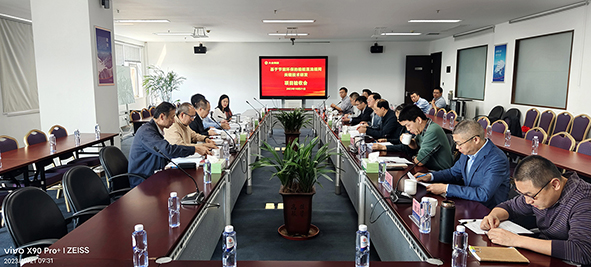

Provincial Key R&D Program is the core technology program of the Provincial Department of Science and Technology, which is divided into general projects and key projects, and the key projects are implemented by several participating units in the form of "project + topic". This project is jointly implemented by Daqo Group, Jiangsu University of Science and Technology, and Jiangsu Shiptek Automation Technology Co., Ltd. The three parties are responsible for the research and development of three sub-topics: DC circuit breaker for marine use, energy matching and management system for marine use, and propulsion inverter for marine use, and on the basis of the acceptance of the three sub-topics, then the acceptance of the general project will be carried out. The three sub-topics have passed the provincial acceptance in the previous period, laying a good foundation for the acceptance of the general topic (project).

The Acceptance Expert Committee considers that: the project proposes the ship power system model optimization and capacity allocation method of DC network, and puts forward the multi-objective energy optimization algorithm based on Pareto dominance relationship, which improves the operation efficiency of the ship and optimizes the ship fuel and emission; it carries out the research on the key factors and their influencing laws in the process of DC disconnection, such as the temperature rise, the performance of the operating mechanism, the electrodynamic characteristics, the arc transfer, the cutting of the grids, and the characteristics of arc extinguishing. And solved difficult problems in the industry, such as DC arc extinguishing and DC intelligent protection; put forward an adaptive PRD control method based on online identification of grid impedance, and established a transient equalization model of parallel power module conduction and a design method of parallel equalization. Successfully developed marine DC circuit breaker, ship energy matching and management system and marine propulsion inverter prototype, after third-party testing and real ship testing, the performance indexes meet the contract requirements, a total of 21 patent applications, including 15 invention patents, and 9 authorized patents, including 3 invention patents. The expert group unanimously agreed that the project passed the acceptance.

According to statistics, since 2021, the construction of new energy inland waterway vessels has shown a spurt of growth in domestic shipyards, and the market size of China's electric vessels will reach 16.87 billion yuan in 2025. The results of the project will be applied to the green transformation of inland navigation and other new energy ship projects to achieve greater economic benefits.
download.jpg download.jpg
Over 10,000+ businesses are already using Daqo products.

The company consistently maintains robust innovative vitality, standing at the forefront of the industry and driving its advancement. Through cutting-edge technologies and products, it achieves goals of energy conservation, environmental protection, quality enhancement, and consumption reduction, continuously contributing to the development of a resource-efficient and environmentally friendly society.